


Cruelty-Free Skincare Routine: 2026 Guide
Table of Contents
- What Makes a Skincare Routine Truly Cruelty-Free
- How to Identify Cruelty-Free Skincare Products
- Vegan vs Cruelty-Free Skincare Differences
- Best Cruelty-Free Skincare Routine for Sensitive Skin
- Budget-Friendly Cruelty-Free Alternatives
- Environmental Impact Beyond Animal Testing
- Conclusion
- Frequently Asked Questions
Last Updated: September 28, 2026
What Makes a Skincare Routine Truly Cruelty-Free
A cruelty-free skincare routine is built entirely from products never tested on animals at any stage, from raw ingredient sourcing to the finished formula. This guide from Blush Boutique breaks down how to build an effective cruelty free skincare routine guide you can trust, without guesswork or greenwashing.
How to Identify Cruelty-Free Skincare Products
Identifying cruelty-free skincare products starts with two checks: a recognized certification logo and an ingredient list free of animal-derived components. Neither takes more than a minute once you know what you're looking at.
Cruelty-Free Certifications and Logos to Look For
Third-party certification is the fastest way to verify a brand's claims. The most recognized programs are the Leaping Bunny logo, which requires independent audits of a company's entire supply chain, and PETA's Beauty Without Bunnies, which maintains a searchable database of verified brands.
Reading Labels: Ingredient Red Flags and Verification Steps
Animal-derived ingredients hide under scientific names. Watch for these common ones:
- Carmine (crushed beetles, used as red pigment)
- Beeswax and honey (bee-derived)
- Lanolin (sheep wool grease)
- Squalene from shark liver (plant-derived squalane is fine)
- Collagen and elastin from animal sources
- Glycerin, which can be animal or plant-based
Vegan vs Cruelty-Free Skincare Differences
Vegan and cruelty-free skincare are not the same thing, and confusing them is the most common mistake in ethical beauty shopping. Vegan refers to ingredients: no animal-derived components. Cruelty-free refers to testing: no animals used to develop or validate the product.
Best Cruelty-Free Skincare Routine for Sensitive Skin
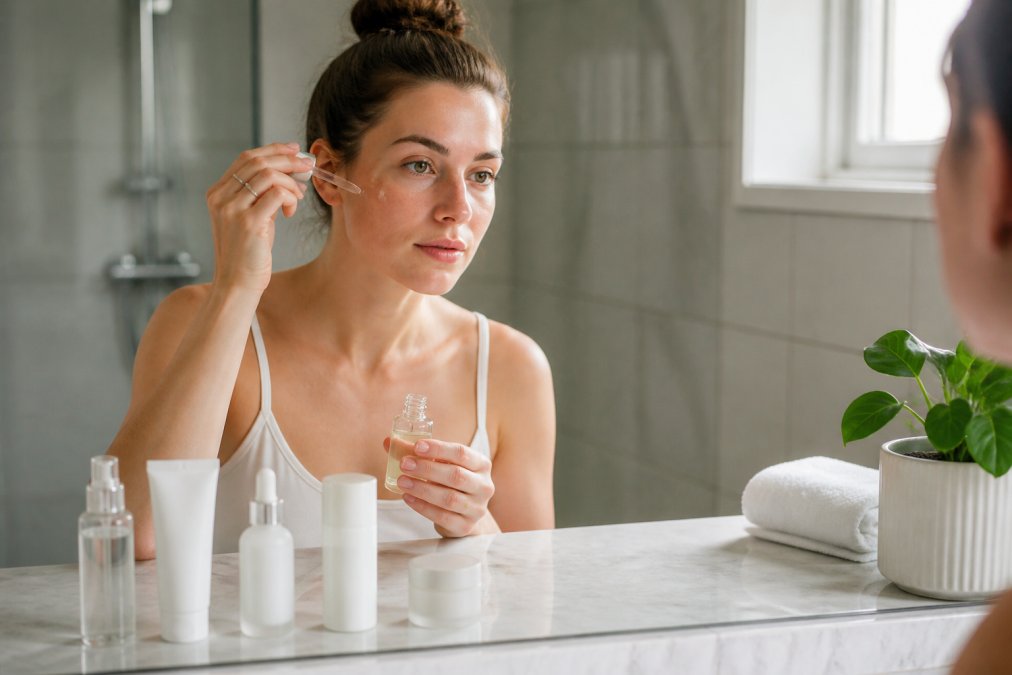
Sensitive skin isn't one condition but a cluster of symptoms: stinging, redness, tightness, and reactive breakouts that flare when the skin barrier is compromised. The barrier is the thin outer layer of lipids and proteins that holds water in and irritants out. When it's damaged, almost anything can trigger a reaction, so a sensitive-skin routine is less about adding soothing ingredients and more about removing what keeps the barrier from repairing itself.
What to Avoid in a Cruelty-Free Sensitive-Skin Routine
Before adding anything, audit what you're already using. These categories are the most common triggers:
- Fragrance, including "natural" fragrance. Essential oils like lavender, citrus, and peppermint are frequent sensitizers. "Unscented" and "fragrance-free" are not the same claim; only fragrance-free is safe for reactive skin.
- Physical scrubs with irregular particles. Ground nutshells and salt crystals create microtears. If you exfoliate, use a soft silicone brush or a gentle chemical exfoliant instead.
- High-percentage acids. Glycolic acid above 10% and salicylic acid above 2% are common culprits. Start lower and less often than the label suggests.
- Alcohol denat and witch hazel. Both strip lipids and leave the barrier more exposed.
- Essential-oil-heavy "calming" products. A product marketed for sensitive skin can still contain the exact oils that trigger it.
Morning Routine: Cleanse, Hydrate, Protect
Three steps, in this order, every day.
- Cleanse with lukewarm water and a sulfate-free, fragrance-free cleanser. Hot water and sulfates both strip the lipid barrier. If skin feels tight afterward, the cleanser is too harsh, not the water temperature.
- Hydrate on damp skin. Apply a humectant serum or essence while skin is still wet. Humectants like hyaluronic acid and glycerin pull water into the upper layers but need moisture to pull from, which is why damp application matters. The Radiant Glow Essence with Hyaluronic Acid is a lightweight $19.95 option that layers under anything without pilling.
- Seal and protect. Follow with a fragrance-free moisturizer, then a broad-spectrum mineral sunscreen. Mineral filters (zinc oxide, titanium dioxide) sit on top of skin rather than absorbing, making them the safer default for reactive skin.
That's the entire morning. Under two minutes, three products, no actives.

Evening Routine: Remove, Repair, Replenish
Evenings are for removal and barrier repair. Order matters more than product count.
- Remove makeup and sunscreen gently. A fragrance-free cleanser handles most of it. For heavy or long-wear makeup, a soft silicone cleansing brush helps without manual scrubbing. The Sonic Cleansing Beauty Brush uses soft silicone and six levels of adjustable sonic vibration, so you can dial it down for reactive skin.
- Treat only if your barrier is stable. This is the step most sensitive-skin routines get wrong. If you're mid-flare, skip actives and go straight to moisturizer. Once skin is calm, a gentle brightening serum is a safer first active than retinol. The Turmeric Radiance Serum uses curcuma longa extract and olive oil and is formulated for sensitive skin at $19.95.
- Replenish while skin is damp. Apply moisturizer within a minute of patting skin dry. Sealing in residual moisture is the single highest-impact step for barrier repair.
Weekly Exfoliation and Masking
Once or twice a week, and only when skin is calm, swap the treatment step for gentle exfoliation. For body and rough patches, the Glow Skin Turmeric Scrub combines turmeric root powder with sodium chloride. For the face, the Turmeric Vitamin C Face Mask draws out impurities in one step. If either stings, stop and return to the three-step baseline for a week.


How to Introduce New Products Without Guessing
Patch test on the inner forearm for 48 hours before applying anything to your face. Then introduce one product at a time, with at least a week between additions. If a reaction appears, you'll know exactly which product caused it. This is slower than most people want, but it's the only way to build a routine you can actually trust.
Budget-Friendly Cruelty-Free Alternatives
Most cruelty-free guides assume a luxury budget. That's wrong, and it's the biggest reason younger shoppers abandon ethical beauty after one purchase. Certified cruelty-free products exist at every price point, including drugstore shelves, and certification is what matters, not the price tag.
The One Rule That Saves the Most Money
Spend on products that stay on your skin longest, save on the ones that rinse off. Cleansers, scrubs, and masks contact skin for seconds to minutes, so a mid-priced option performs nearly as well as a luxury one. Serums, moisturizers, and sunscreens stay on for hours, which is where formulation quality shows up in results.
Radiant Glow Essence with Hyaluronic →
| Routine Step | Where to Save | Where to Spend | Why |
|---|---|---|---|
| Cleanser | Mid-priced, sulfate-free | - | Rinses off in under a minute |
| Exfoliant | Basic physical scrub or soft brush | - | Contact time is brief |
| Serum | - | Targeted treatment | Sits on skin for hours |
| Moisturizer | - | Barrier-supporting formula | Full-day contact |
| Sunscreen | Any certified option | - | Reapply often regardless |
How to Verify a Budget Product Is Actually Cruelty-Free
Low price is not a red flag, but an unverified claim is. Two certification programs make budget shopping straightforward:
- Leaping Bunny. Requires independent audits of the entire supply chain, including ingredient suppliers, and prohibits animal testing at every stage. The program publishes a searchable list of certified brands that spans drugstore to prestige.
- PETA Beauty Without Bunnies. A searchable database of brands that have committed to no animal testing. The verification standard is lighter than Leaping Bunny's, but the database is broad and free to search.
Where Budget Cruelty-Free Products Actually Live
Three reliable categories to shop:
- Drugstore and mass-market lines. Major retailers now carry certified lines across cleansers, moisturizers, and sunscreens. Certification has moved down-market significantly over the past decade.
- Refill and subscription formats. Refill pouches and concentrated formats cut both packaging cost and per-use price. A refillable serum can cost less per ounce than the original bottle.
- Multi-tasking formulas. A tinted mineral sunscreen replaces sunscreen plus foundation. A cleansing balm replaces makeup remover plus cleanser. Fewer products, lower total spend.
A Realistic Starter Budget
You don't need to replace everything at once. Swap products as they run out, starting with the ones you use most. A cleanser, moisturizer, and sunscreen are the three highest-impact swaps, all available certified at drugstore prices. Serums and treatments can wait until your baseline is set.
The Environmental Layer Most Budget Guides Skip
Affordability and sustainability aren't in conflict. Refill formats cut both cost and plastic waste. Concentrated formulas ship smaller and lighter, cutting packaging and transport emissions. Bar cleansers and moisturizers eliminate plastic bottles entirely and typically cost less per use than liquids. If budget and environmental impact both matter, refillable and concentrated formats are where the two overlap.
Environmental Impact Beyond Animal Testing
Animal testing is only one part of a product's environmental footprint, and the part most guides stop at. The bigger picture includes packaging, ingredient sourcing, water use in formulation, and shipping distance.
Three factors worth weighing:
- Packaging: Glass and aluminum are more recyclable than mixed plastics. Refill options cut waste significantly over time.
- Ingredient sourcing: Palm oil derivatives are common in skincare, and unsustainable sourcing drives deforestation. Look for roundtable-certified palm or palm-free formulas.
- Supply chain transparency: Brands that publish supplier information make it easier to verify both ethical and environmental claims. Transparency is a proxy for accountability.
Conclusion
The hardest part of going cruelty-free isn't finding products. It's cutting through the labels, unverified claims, and vegan-versus-cruelty-free confusion long enough to build a routine that works for your skin. That's the real barrier, and why so many people stall out after one bad purchase.
Frequently Asked Questions
How do I know if my skincare is truly cruelty-free?
Check for third-party certifications like Leaping Bunny or PETA's Beauty Without Bunnies logo. These require brands to verify no animal testing at any stage, including ingredient suppliers. Also look for a clear statement on the brand's website about their testing policy. If a product says 'cruelty-free' but lacks certification, contact the company directly. Blush Boutique is committed to cruelty-free practices and transparent sourcing.
What is the difference between vegan and cruelty-free skincare?
Vegan means no animal-derived ingredients (like honey, beeswax, or collagen). Cruelty-free means no animal testing. A product can be cruelty-free but contain animal byproducts, or vegan but tested on animals. For an effective cruelty-free skincare routine, look for both labels. Blush Boutique's products are cruelty-free and made with clean ingredients.
How do I build a simple cruelty-free skincare routine for beginners?
Start with three core steps: a gentle cleanser, a hydrating serum, and a moisturizer. For mornings, add a sunscreen. For evenings, double cleanse if you wear makeup. Blush Boutique's Radiant Glow Essence with Hyaluronic Acid ($19.95) works as a hydrating step. Keep it consistent and introduce active ingredients like turmeric serum gradually.
Are cruelty-free products as effective as traditional skincare?
Yes. Cruelty-free brands use the same proven ingredients like hyaluronic acid, vitamin C, and retinol alternatives. Effectiveness depends on formulation, not animal testing. Many cruelty-free products are dermatologist-tested and non-comedogenic. For example, Blush Boutique's Turmeric Radiance Serum targets dark spots with clinically studied curcuma longa extract. You don't sacrifice results for ethics.
Which certifications should I look for on cruelty-free skincare labels?
The most reliable are Leaping Bunny (from Cruelty Free International) and PETA's Beauty Without Bunnies. Leaping Bunny requires independent audits and prohibits animal testing at every stage. PETA's logo indicates a pledge against testing. Some brands also carry vegan trademarks. Always verify the certification is current and applies to the specific product.
Can I transition to a cruelty-free routine without breaking the bank?
Absolutely. Start by replacing one product at a time as you run out. Budget-friendly options exist, like Blush Boutique's Turmeric Radiance Serum at $19.95. Look for multi-tasking products that simplify your routine. Many drugstore brands are now cruelty-free. Focus on essentials first: cleanser, moisturizer, and sunscreen. You can build an effective cruelty-free skincare routine without spending more.