


Does Clean Makeup Provide Full Coverage? The 2026 Guide
Table of Contents
- Clean Makeup Coverage: What the Labels Don't Tell You
- Buildable vs Full Coverage Foundation: What's the Real Difference?
- Ingredients That Decide Whether Clean Makeup Can Go Full Coverage
- Best Clean Beauty Foundations for Full Coverage (and What to Look For)
- How to Apply Clean Foundation for Maximum Coverage
- Clean Makeup and Skin Health: The Trade-Off Nobody Mentions
- Frequently Asked Questions
Last Updated: September 15, 2026
Clean Makeup Coverage: What the Labels Don't Tell You
Does clean makeup provide full coverage? Yes, but only when the formula and your application method work together. This guide from Blush Boutique breaks down exactly how clean pigments, layering, and technique combine to reach full opacity without synthetic fillers. Most "clean" foundations marketed as full coverage rely on titanium dioxide and iron oxides at high concentrations. Those minerals can absolutely deliver opaque results. The catch is texture. High mineral loads tend to look chalky unless the formula includes enough emollient to bind them to skin.
Here's what matters most: coverage is a function of pigment density and how you build it, not whether the label says "clean."
Buildable vs Full Coverage Foundation: What's the Real Difference?
Buildable vs full coverage foundation comes down to pigment load per layer. A buildable formula starts sheer and lets you add thin layers until you hit your desired opacity. A full-coverage formula delivers maximum pigment in a single pass.
Buildable foundations typically contain 8-15% pigment by weight. Full-coverage conventional formulas push past 20%. Clean brands often land in the middle, which is why layering matters so much.
When Buildable Beats Full Coverage
Buildable wins for daily wear. You get a skin-like texture that doesn't flatten your face, and you can spot-conceal only where needed. For anyone with relatively even skin tone and a few blemishes, a buildable formula applied in two thin layers looks more natural than one thick pass of full-coverage product.
How to Layer Buildable Formulas to Full Opacity
The method is straightforward but requires patience:
- Start with a primer suited to your skin type
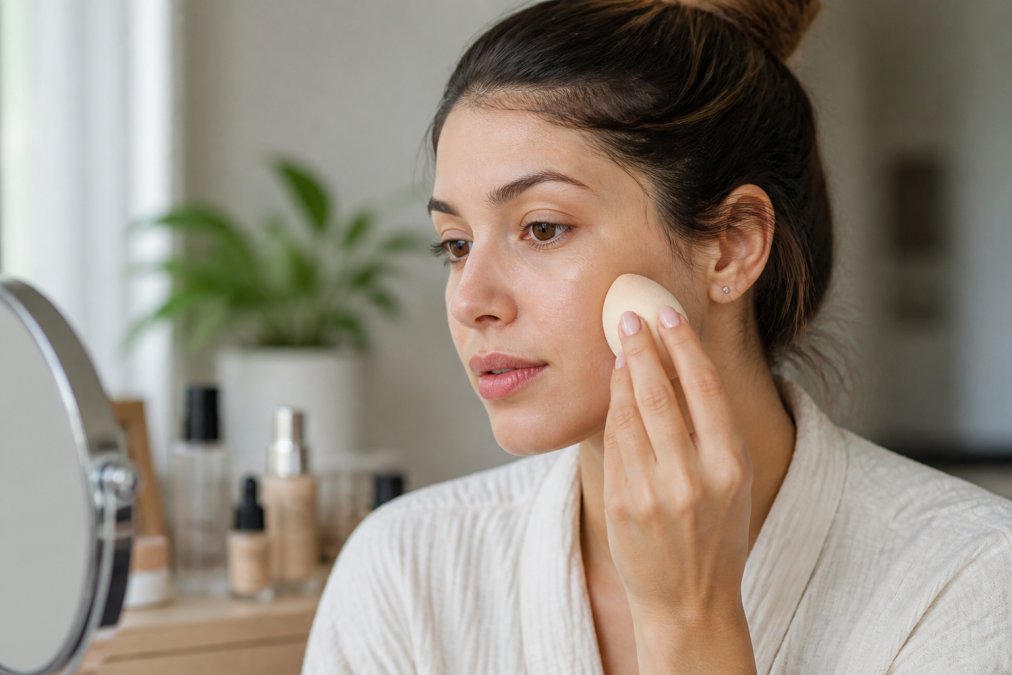
- Apply a thin first layer with a damp sponge, pressing rather than sweeping
- Wait 60 seconds for the formula to set
- Add a second thin layer only on areas needing more coverage
- Spot-conceal blemishes and hyperpigmentation with a concentrated concealer
- Set with a light dusting of translucent powder
Each layer adds roughly 30-40% more opacity (pubmed.ncbi.nlm.nih.gov). Three thin layers typically match one full-coverage application, with a far better finish.
| Coverage Level | Layers Needed | Best For | Finish |
|---|---|---|---|
| Sheer | 1 thin layer | Even skin tone, casual days | Dewy or satin |
| Medium | 2 thin layers | Minor blemishes, redness | Satin |
| Full | 3 thin layers + concealer | Hyperpigmentation, acne | Matte or satin |
Ingredients That Decide Whether Clean Makeup Can Go Full Coverage
Pigment type is the single biggest factor. Mineral pigments like titanium dioxide, zinc oxide, and iron oxides provide opacity without synthetic dyes. Their particle size determines whether they sit on top of skin or blend into it.
Micronized minerals give a smoother, more skin-like texture. Non-micronized versions deliver heavier coverage but can look powdery.
The base matters just as much. Clean formulas use oils like jojoba, squalane, or coconut-derived emollients to bind pigments. A formula with too little emollient will separate and cling to dry patches. Too much, and it slides off by midday.
Watch for these in clean foundations:
- Comedogenic oils like coconut oil can clog pores on acne-prone skin
- Alcohol denat as a primary ingredient dries out the skin barrier
- Fragrance (even "natural" essential oils) can trigger reactions on sensitive skin
A common mistake is assuming "clean" means "gentle." Some natural pigments and botanical extracts cause irritation just as easily as synthetic ones. Patch testing on your jawline for 24 hours before full application is non-negotiable.
Best Clean Beauty Foundations for Full Coverage (and What to Look For)
Most "best clean foundation" roundups rank products by personal preference. That approach tells you what one tester liked, not why a formula reaches full coverage. The more useful filter is ingredient-level: which pigments, at what concentration, suspended in which base. That is what determines whether a clean foundation actually delivers opacity or fades into a tinted moisturizer by noon.
Read the Pigment System First
Full-coverage clean foundations almost always lean on the same mineral trio: titanium dioxide, zinc oxide, and iron oxides. Each behaves differently.
- Titanium dioxide is the workhorse for opacity. It has a high refractive index, meaning it scatters light efficiently and reads as bright white before it is tinted. Formulas that list it first or second on the ingredient deck (INCI order reflects concentration) tend to build coverage faster.
- Zinc oxide adds opacity but also a characteristic slip and a slight cast. It is often used at lower percentages than titanium dioxide because it can feel heavy and drying at high loads.
- Iron oxides are the colorants. They do not add much opacity on their own, but they determine whether the base reads as a neutral, warm, or cool shade. A formula with strong titanium dioxide and a narrow iron oxide range will look opaque but flat; a broader iron oxide blend gives dimension.
A practical rule: if titanium dioxide and zinc oxide appear in the first five ingredients and iron oxides appear before the halfway point, the formula has the raw material to reach full coverage. If titanium dioxide sits near the bottom of the list, no amount of layering will get you past medium.
Match the Base to Your Skin Type
The pigment system gets you opacity. The base determines whether that opacity stays put or breaks apart.
- Dry and mature skin does best with emollient-rich bases: squalane, jojoba, or plant-derived glycerin near the top of the deck. These bind mineral pigments to skin and prevent the chalky, powdery look that high titanium dioxide loads can produce. A common pattern is a cream or balm foundation rather than a liquid.
- Oily skin needs a lighter, more volatile base. Look for formulas where the first emollient is a lightweight ester or a silicone alternative rather than a heavy oil. Heavy oils plus high pigment load is the fastest route to a formula that slides off the T-zone by early afternoon.
- Combination and acne-prone skin benefits from non-comedogenic emollients. Coconut oil and coconut-derived ingredients are common in clean formulas and are a frequent trigger for clogged pores. Squalane and jojoba are generally better tolerated.
The Evaluation Checklist That Actually Predicts Performance
When comparing two clean full-coverage foundations, work through these in order:
- Pigment position on the INCI deck. Titanium dioxide and zinc oxide in the top five is the strongest single predictor of coverage.
- Pigment percentage if disclosed. Some brands publish it. Anything at or above 15% by weight is in full-coverage territory; 8-15% is buildable.
- Finish type. Dewy for dry skin, satin for normal and combination, matte or soft-matte for oily. A matte finish on dry skin will emphasize texture regardless of pigment load.
- Oxidation behavior. Swatch on your jawline and wait 20 minutes in natural light. Mineral pigments oxidize less than synthetic-dye formulas, but oily skin can still shift a shade warmer.
- Shade range depth. Clean lines often carry fewer shades, so the gap between two adjacent options can be larger. If you fall between two, go warmer for foundation and correct with concealer rather than trying to split the difference.
- Third-party testing claims. "Dermatologist-tested" and "hypoallergenic" mean little without a named testing protocol. Cruelty-free certification from a recognized body is verifiable; a brand's own claim is not.
Layering Compatibility: The Step Most Guides Skip
Full coverage with clean makeup usually means pairing a foundation with a clean concealer. That pairing is where formulas fail.
How to Apply Clean Foundation for Maximum Coverage
Tools and Technique: What Actually Moves the Needle
Three technique rules that make the biggest difference:
Clean Makeup and Skin Health: The Trade-Off Nobody Mentions
Why the Base Matters More Than the Label
The Environmental Angle Most Guides Ignore
Practical Skin-Health Rules for Full-Coverage Wear
Frequently Asked Questions
Can clean beauty products achieve a full-coverage finish?
Yes, but the approach differs from conventional makeup. Clean makeup coverage relies on buildable layering, natural pigments like iron oxides and zinc oxide, and strategic application technique rather than heavy silicones and synthetic fillers. Formulas that use concentrated mineral pigments and skin-like textures can reach full opacity in two to three thin layers. The key is choosing products designed for layering and using the right tools, such as a damp sponge for pressing product into the skin rather than sweeping it across the surface.
What is the best clean foundation with full coverage?
The best clean beauty foundations for full coverage share a few traits: concentrated mineral pigments, a satin or natural finish that doesn't oxidize, and a formula free of pore-clogging ingredients. Look for foundations with iron oxides listed high in the ingredient deck. Stick foundations and cream-to-powder formulas tend to offer the most opacity from clean brands because they contain fewer water-based fillers. Always patch test on your jawline before committing to a full face.
How does clean foundation compare to conventional full-coverage makeup?
Conventional full-coverage foundations often use silicones like dimethicone to create a smooth, opaque film quickly. Clean formulas skip those ingredients and instead rely on pigment concentration and layering. The result: clean foundation may need an extra layer or two to reach the same opacity, but it tends to feel lighter on the skin and is less likely to clog pores over time. Wear-time can be comparable when you set with a clean powder and use a primer suited to your skin type.
What ingredients should I look for in a full-coverage clean foundation?
Prioritize iron oxides and titanium dioxide for pigment, zinc oxide for both coverage and skin-soothing properties, and jojoba or squalane for slip without pore-clogging. Avoid formulas where alcohol denat appears in the first five ingredients, since it can disrupt the skin barrier and cause oxidation. Also check for the words non-toxic and synthetic-free on the label. A short ingredient list with recognizable natural pigments usually signals a formula built for buildable coverage that won't irritate sensitive skin.