


Clean Beauty Without Synthetic Fragrances: 2026 Guide
Table of Contents
- What 'Clean Beauty Without Synthetic Fragrances' Actually Means
- How to Read Fragrance Ingredients on a Beauty Label
- Fragrance-Free Skincare for Sensitive Skin: What to Look For
- Natural Perfumes and Botanical Scents: Do They Perform?
- How to Evaluate Clean Fragrance Brands and Their Claims
- Comparison Table: Blush Boutique Fragrance-Free Skincare Picks
- Conclusion: Building a Clean Routine That Works for Your Skin
- Frequently Asked Questions
Last Updated: October 7, 2026
What 'Clean Beauty Without Synthetic Fragrances' Actually Means
The term clean beauty has no legal definition. This guide breaks down what the words mean, how to read a fragrance ingredient list, and which formulas suit sensitive skin.
"Clean" is a marketing term, not a regulated one. A product can be labeled clean, natural, or botanical while still containing synthetic fragrance, preservatives, or dyes. The ingredient list, specifically how the fragrance portion is written, is the only reliable signal.
Clean, Natural, Synthetic-Free, and Fragrance-Free: The Real Definitions
These four terms are not interchangeable.
- Clean: A marketing category, not a regulated one. Generally implies a shorter ingredient list and avoidance of certain flagged ingredients, but the specific exclusions vary by brand.
- Natural: Ingredients derived from plants, minerals, or other natural sources. "Natural" does not automatically mean gentle or safe for sensitive skin.
- Synthetic-free: Contains no lab-made ingredients. Rare in practice, since preservatives and emulsifiers are often synthetic even in otherwise botanical formulas.
Why the FDA Doesn't Define 'Clean' and What That Means for You
The FDA regulates cosmetics for safety and labeling but has not defined "clean," "natural," or "botanical," so those words can appear on packaging with wide latitude. The ingredient list is the only reliable signal, and even that has an exception.
How to Read Fragrance Ingredients on a Beauty Label
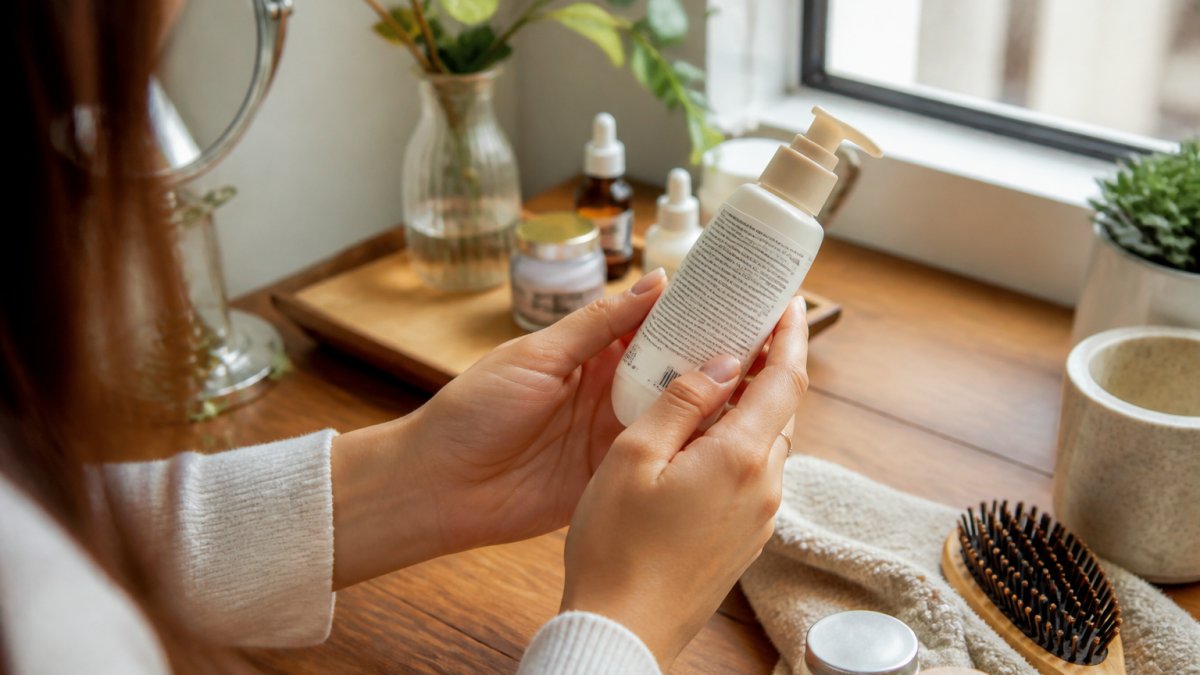
Reading a fragrance ingredient list comes down to four steps: check the position of "fragrance" or "parfum," note whether an allergen disclosure follows it, look for essential oils listed by name, and confirm the product says "fragrance-free" rather than "unscented."
The 'Fragrance' Loophole and What It Hides
Under U.S. labeling rules, "fragrance" can stand in for dozens of compounds, concealing a mix of synthetic aroma chemicals, essential oils, or both. That is why "clean" claims are hard to verify: the formula may be 95% disclosed and 5% unknown, and that unknown portion often causes reactions.
Terms to Watch: Parfum, Aroma, Essential Oil Blends
Several words point to the same hidden category:
- Parfum and fragrance: catch-all terms for a scent blend, often undisclosed
- Aroma: similar catch-all, common on imported formulas
- Essential oil blends: natural, but not automatically gentle. Citrus, lavender, and peppermint oils are frequent irritants
A common mistake is assuming "essential oil" means "safe for sensitive skin." Plant-derived oils can trigger reactions just as easily as synthetic ones.
Fragrance-Free Skincare for Sensitive Skin: What to Look For
Fragrance-free skincare for sensitive skin should prioritize short ingredient lists, clearly named ingredients, and the absence of both "fragrance" and "parfum." Look for products that state "fragrance-free" explicitly, avoid added essential oils, and disclose their full ingredient list.
If you have reacted to a "clean" product before, the culprit was often an undisclosed fragrance or botanical oil, not the base formula.
Our Turmeric Radiance Serum is built around curcuma longa extract, olive oil, sodium polyacrylate, and water, with no added fragrance in the formula.

Natural Perfumes and Botanical Scents: Do They Perform?
Natural perfumes and botanical scents can perform well, but they behave differently from synthetic fine fragrance. Plant-based scent molecules are smaller and more volatile, so they evaporate faster and sit closer to the skin. A botanical eau de parfum may last three to four hours where a synthetic formula lasts longer, and it may project less. That is a trade-off, not a flaw: botanical formulas suit a subtle scent that fades naturally; for all-day projection, expect to reapply.
Why Wear Time Differs: Concentration and Format
Wear time depends on concentration and format. From lightest to longest-lasting:
- Body mists and splashes. Lowest concentration, typically a few hours at most, and the easiest entry point for scent-sensitive users.
- Eau de toilette. Lighter concentration, generally a few hours.
- Eau de parfum. Higher concentration, often the longest-lasting of the alcohol-based formats.
For botanical formulas, volatile plant molecules mean you should expect the shorter end of each range. A botanical eau de parfum lasting three to four hours is performing normally.
How to Make a Botanical Scent Last Longer
You cannot change the chemistry, but you can slow the fade:
- Apply to moisturized skin. Dry skin releases scent faster; a fragrance-free moisturizer underneath gives the scent something to hold onto.
- Target pulse points. Wrists, inner elbows, and the base of the throat are warmer, which helps release scent gradually.
- Layer formats. A matching body product under a spray can extend wear without adding a second, competing scent.
For scent without a full fragrance routine, a scented body product is often easier. Our Glow Skin Turmeric Scrub ($27.95) uses lavender extract and a turmeric aroma blend for a soft scent while it exfoliates, so the fragrance is incidental rather than the point.

The Environmental Trade-Offs Nobody Mentions
"Natural" and "sustainable" are not the same thing, and botanical sourcing carries its own footprint:
- Land, water, and yield. Botanical ingredients often require more land and water per unit of usable material than lab-made equivalents, and harvests vary by season and region.
- Packaging. Glass is heavier to ship than plastic, and heavy packaging raises transport emissions even when the material itself is recyclable.
- Refills and formats. A refillable bottle or a concentrated format that uses less packaging per use can matter more than whether the scent is plant-derived.
The honest takeaway: a botanical formula is not automatically lower-impact, and a synthetic one is not automatically worse. Packaging weight, refill options, and reapplication frequency all affect the real footprint, so weigh those alongside the ingredient list rather than treating "natural" as a sustainability claim.
How to Evaluate Clean Fragrance Brands and Their Claims
Evaluating clean fragrance brands comes down to disclosure, but "disclosure" is not a yes-or-no question. A brand can publish a full ingredient list and still tell you almost nothing about its scent blend, because labeling rules allow one catch-all term to stand in for a compound mixture. The real skill is knowing what an ingredient list can and cannot reveal, then scoring brands on consistent criteria instead of trusting the word "clean."
What an Ingredient List Can and Cannot Tell You
An ingredient list names ingredients in descending order of concentration, with the fragrance portion listed as "fragrance" or "parfum." That single entry can legally represent dozens of aroma compounds, synthetic, essential oils, or both, without naming any.
What the list can reveal:
- Position of the fragrance entry. Ingredients are listed in descending order, so "fragrance" appearing near the end suggests a lower concentration than one appearing near the top.
- Named essential oils. If a brand lists individual oils by name (lavender oil, citrus peel oil), that is a disclosure choice beyond the legal minimum.
- Preservatives and emulsifiers. These are usually synthetic even in botanical formulas, which is why "synthetic-free" is rare in practice.
What the list cannot reveal:
- The specific aroma chemicals inside a "fragrance" or "parfum" entry.
- Whether that blend is plant-derived, lab-made, or a mix.
- The concentration of any individual component.
A brand that goes beyond the minimum, naming fragrance components, publishing an allergen breakdown, or explaining sourcing, gives you verifiable information. One that relies on "clean" and "fragrance" alone does not.
A Transparent Scorecard for Comparing Brands
Because claims are inconsistent, a fixed scorecard makes brands comparable. Score each brand on the criteria below.
| Criterion | What to check | Why it matters |
|---|---|---|
| Ingredient disclosure | Full list published, fragrance components named where possible | Lets you verify claims instead of trusting them |
| Allergen transparency | Common fragrance allergens flagged by name | Helps you cross-check against known sensitivities |
| Certification | Recognized third-party certifications where applicable | Independent verification beats self-declaration |
| Cruelty-free and vegan status | Stated clearly and specifically, not vaguely | Distinguishes a real policy from a marketing line |
| Sampling options | Discovery sets or small formats available | Lets you test before committing to a full bottle |
Use the same five criteria for every brand. A brand with a full list but no samples is harder to test; one with great samples but a vague ingredient list is harder to verify. The scorecard keeps you from over-weighting whichever claim is loudest on the packaging.
Cost, Concentration, and Value
Sticker price alone is misleading. What matters is price per milliliter combined with concentration and expected wear time. A botanical eau de parfum may cost more per ounce than a synthetic formula because plant-derived ingredients are costlier to source and stabilize, and it may fade faster, meaning more reapplication.
To compare, divide the price by the volume in milliliters, then factor in how many hours the scent lasts on your skin.
Sensitivity and Patch Testing
No ingredient list can predict whether a product will irritate your skin. Fragrance is one of the most common causes of cosmetic contact reactions, and both synthetic aroma chemicals and natural essential oils can trigger them, plant-derived does not mean irritation-free.
If you have reactive skin, patch test before full use: apply a small amount to your inner forearm, leave it 24 hours, and check for redness, itching, or swelling.
Comparison Table: Blush Boutique Fragrance-Free Skincare Picks
Here is how our fragrance-free and low-fragrance skincare picks compare on price, key ingredients, and best use.
| Product | Price | Key Ingredients | Best For | Fragrance |
|---|---|---|---|---|
| Turmeric Radiance Serum | $19.95 | Curcuma longa, olive oil, sodium polyacrylate, water | Dark spots, uneven tone, sensitive skin | No added fragrance |
| Radiant Glow Essence with Hyaluronic Acid | $19.95 | Hyaluronic acid | Hydration, plumping, texture and elasticity | No added fragrance |
| Turmeric Vitamin C Face Mask | $22.95 | Vitamin C, organic turmeric | Deep cleansing, brightening, unclogging pores | No added fragrance |
| Glow Skin Turmeric Scrub | $27.95 | Sodium chloride, lavender extract, turmeric aroma | Exfoliation, dry heels, body care | Contains lavender and turmeric aroma |
The Radiant Glow Essence with Hyaluronic Acid ($19.95, 50ml) is the simplest starting point for hydration without scent.

The Turmeric Vitamin C Face Mask ($22.95) targets dullness and clogged pores.
One honest limitation: the Glow Skin Turmeric Scrub contains lavender extract and a turmeric aroma blend, so it is not fragrance-free.
Conclusion: Building a Clean Routine That Works for Your Skin
The hardest part of shopping for clean beauty without synthetic fragrances is that labels do not do the work for you.
We built Blush Boutique to make that easier. Every product is cruelty-free, made with clean ingredients, and designed for real skin, with fast shipping and a 30-day money-back guarantee.
Shop Now and find the fragrance-free essentials that fit your skin.
Frequently Asked Questions
Which fragrances are not synthetic?
Fragrances derived entirely from botanical sources, such as essential oils and plant extracts, are considered non-synthetic. Examples include lavender oil, bergamot extract, and turmeric aroma. However, 'natural' does not automatically mean safer. Essential oils can still trigger allergic reactions in sensitive skin. If you want zero fragrance of any kind, look for products labeled fragrance-free rather than natural perfume. Blush Boutique's Glow Skin Turmeric Scrub uses lavender extract and turmeric aroma for scent, while the Turmeric Radiance Serum is formulated without added fragrance.
How can I tell if a beauty product contains synthetic fragrance?
Check the ingredient list for terms like 'fragrance,' 'parfum,' 'aroma,' or 'perfume.' Under FDA labeling rules, companies can group dozens of individual scent chemicals under the single word 'fragrance' without disclosing them. If a product lists 'fragrance' or 'parfum' and does not specify the source, you cannot confirm whether it is synthetic or natural. Products that are truly fragrance-free will state so on the front label and will not list fragrance, parfum, or aroma in the ingredients.
Are natural fragrances safer than synthetic fragrances?
Not necessarily. The American Academy of Dermatology notes that fragrance is the most common cause of allergic contact dermatitis in cosmetics, and that applies to both natural and synthetic sources. Essential oils like lavender and citrus can cause irritation just as synthetic compounds can. The key difference is disclosure: natural fragrance ingredients are sometimes listed individually, giving you more information to make a decision. If your skin is reactive, fragrance-free skincare is the safest choice regardless of whether the scent is natural or synthetic.
What does fragrance-free mean on a beauty product label?
Fragrance-free means no fragrance ingredients have been added to the product for scent purposes. It does not always mean zero scent, because raw ingredients can carry a natural odor. The FDA does not formally regulate the term, so some products labeled 'unscented' may contain masking fragrances to cover raw ingredient smells. For the strictest interpretation, look for products that state 'fragrance-free' and list no fragrance, parfum, or aroma in the ingredient panel. Blush Boutique's Turmeric Radiance Serum and Radiant Glow Essence are formulated without added fragrance.
What can I use instead of perfume if I want to avoid synthetic fragrance?
You have a few options. First, try a body care product with a naturally derived scent, like Blush Boutique's Glow Skin Turmeric Scrub, which uses lavender extract and turmeric aroma. Second, explore natural perfumes made from essential oils and plant extracts, though these still carry allergy risk for sensitive skin. Third, if your goal is purely to avoid synthetic fragrance and not scent itself, look for products that disclose every fragrance ingredient by name. Always patch-test any new scented product on your inner arm for 24 hours before applying it more broadly.