


How to Build a Simple Clean Beauty Routine in 2026
Table of Contents
- What You'll Need Before You Start
- Step 1: Identify Your Skin Type and Concerns
- Step 2: How to Read Skincare Ingredient Labels Like a Pro
- Step 3: Minimalist Skincare Routine Steps for Morning and Evening
- Step 4: How to Transition to Clean Beauty Without Wasting Money
- Common Mistakes That Ruin a Clean Beauty Routine
- Conclusion
- Frequently Asked Questions
Last Updated: September 11, 2026
What You'll Need Before You Start
Building a simple clean beauty routine starts with less than you think: a gentle cleanser, one treatment, a moisturizer, and sunscreen. That's it. The average bathroom shelf holds far more, but a clean beauty routine works best when it stays minimal and consistent.
This guide walks through the full process, from identifying your skin type to reading ingredient labels and swapping products without wasting money.
Before you buy anything, gather three things. First, a clear picture of your skin type and its main concern, whether that's dryness, oiliness, or sensitivity. Second, a way to read labels, since "clean" is a marketing term, not a regulated one. Third, a plan for phasing products in one at a time so you can tell what actually works.
You'll also want a patch-testing habit. Apply any new product to a small area of skin, usually behind the ear or on the inner forearm, and wait 24 to 48 hours before using it on your face (the American Academy of Dermatology). This single step prevents most of the irritation people blame on "clean beauty" as a category.
Step 1: Identify Your Skin Type and Concerns
Your skin type determines which textures and ingredients belong in your routine. Get this wrong and even good products underperform.
Here's a quick way to tell. Wash your face with a mild cleanser, wait one hour without applying anything, then press a blotting sheet against your forehead, nose, and cheeks.
- Oily: shine across all zones
- Dry: tightness or flaking, no shine
- Combination: shine in the T-zone only
- Normal: comfortable, no tightness or shine
- Sensitive: redness, stinging, or reactivity to new products
From there, note your primary concern: acne, dark spots, dullness, or fine lines. Pick one. Routines that chase three concerns at once tend to irritate skin and get abandoned within a month.
Step 2: How to Read Skincare Ingredient Labels Like a Pro
Learning how to read skincare ingredient labels is the single skill that separates a genuinely clean routine from a label-driven one. Ingredients are listed by concentration, from highest to lowest, so the first five names tell you most of what you need to know.
Humectants draw water into the skin. Look for glycerin, hyaluronic acid, and aloe. Emollients soften and smooth. Think squalane, jojoba oil, and shea butter. Antioxidants like vitamin C and green tea help defend against free radical damage from sun and pollution.

Red Flags and Green Flags on Ingredient Lists
Red flags are not always about a single ingredient. Fragrance is the most common trigger for skin sensitivity, and "fragrance" on a label can hide dozens of undisclosed compounds (the American Academy of Dermatology). Synthetic fragrances, drying alcohols high on the list, and harsh sulfates are worth avoiding if your skin is reactive or acne-prone.
Green flags look different. Non-comedogenic formulas won't clog pores. Dermatologist-tested and hypoallergenic claims mean the brand ran some form of testing, though neither term is legally defined, so treat them as signals rather than guarantees. Paraben-free and sulfate-free labels matter less than whether the formula suits your skin, but they're reasonable starting filters.
What "Clean" Actually Means, and Who Certifies It
The term "clean" has no legal definition in the U.S. The FDA's cosmetics labeling guidance explains that cosmetic ingredients and labeling fall under specific federal rules, and "clean" is not one of the regulated claims. That's why reading the actual ingredient list beats trusting a badge on the front of the bottle.
Because "clean" is unregulated, the real authority comes from third-party certification and retailer standards. A few you can actually verify:
- Made Safe screens products against a restricted list of ingredients linked to human health or environmental harm and publishes the results.
- EWG Verified requires full ingredient disclosure, restricted-ingredient screening, and a review of manufacturing practices.
- Leaping Bunny and Cruelty Free International certify that no animal testing occurred at any stage of production.
- USDA Organic and NSF/ANSI 305 apply to the organic content of a formula, not to its safety overall.
- Whole Foods Premium Body Care and Credo Clean Standard are retailer-run standards that ban specific ingredient classes (such as certain parabens, phthalates, and formaldehyde releasers) and publish their restricted lists.
None of these certifications guarantee a product will suit your skin. They guarantee that a third party checked the formula against a published standard, which is more than a front-of-bottle "clean" claim does.
The Ingredient Classes Most Standards Restrict
If you want a shortcut, these are the ingredient families most clean standards screen out, and why:
- Phthalates, often hidden inside "fragrance"; linked to endocrine disruption in some studies.
- Parabens (propyl-, butyl-, isopropyl-, isobutyl-), preservatives restricted under some retailer standards; methyl- and ethylparaben are usually permitted.
- Formaldehyde releasers (DMDM hydantoin, diazolidinyl urea, quaternium-15), preservatives that can release small amounts of formaldehyde over time.
- Cyclic silicones (D4, D5, D6), restricted in some standards over environmental persistence.
- Chemical UV filters like oxybenzone and octinoxate, restricted in some retailer standards and in certain state-level sunscreen rules.
This is not a list of "toxic" ingredients. It's a list of ingredients that a meaningful share of clean standards have chosen to exclude, usually for a mix of health, environmental, and disclosure reasons. Knowing which standard a brand follows tells you more than any single ingredient name.
Step 3: Minimalist Skincare Routine Steps for Morning and Evening
A minimalist skincare routine has four steps in the morning and four at night. Consistency matters more than the number of products, and most people see better results from four well-chosen items than from ten they use sporadically.
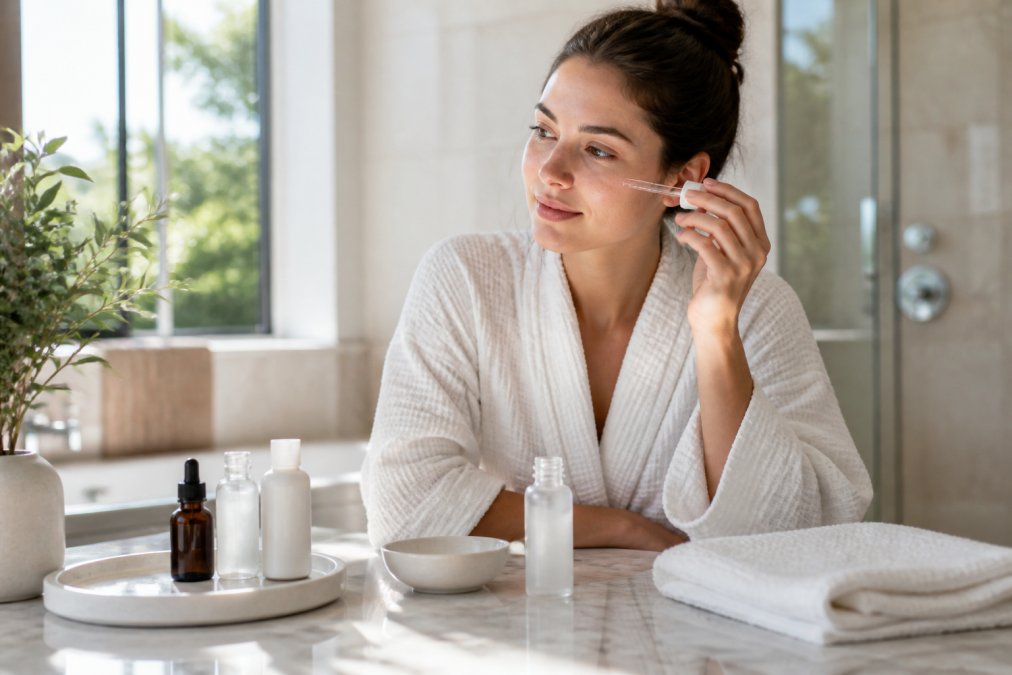
Morning Routine: Cleanse, Hydrate, Protect
- Cleanse. A gentle rinse or mild cleanser removes overnight sebum without stripping the skin.
- Hydrate. Apply a hydrating essence or serum to damp skin. The Radiant Glow Essence with Hyaluronic Acid is built around hyaluronic acid, which supports moisture retention and plumps the skin.
- Moisturize. Seal in hydration with a lightweight moisturizer suited to your skin type.
- Protect. Finish with broad-spectrum sunscreen. This is the non-negotiable step for preventing dark spots, dullness, and collagen breakdown.
Evening Routine: Cleanse, Treat, Repair
- Remove makeup. A cleansing balm or facial oil breaks down makeup and sunscreen without tugging.
- Cleanse again. A second, gentler wash clears what the oil left behind.
- Treat. This is where active ingredients belong. A serum targeting dark spots or uneven tone goes here.
- Repair. A richer moisturizer or facial oil supports the skin barrier overnight, when cellular turnover peaks.
Step 4: How to Transition to Clean Beauty Without Wasting Money
Switching to clean beauty works best as a slow swap, not a full shelf clear-out. Replace products as they run out, one at a time, so you can isolate what helps and what irritates.

Start with the products that sit on your skin longest: cleanser, moisturizer, and sunscreen. These have the most contact time and the biggest impact on your skin barrier. Makeup and treatment serums can follow.
Budget matters here too. A clean routine doesn't require luxury pricing. A focused essence or serum in the $20 range can carry the treatment step of your entire routine, which is where most people overspend.
Swap One Product at a Time
Give each new product two to three weeks before adding the next. If your skin reacts, you know exactly which item caused it. If it thrives, you've confirmed a keeper.
The Turmeric Radiance Serum is a good example of a single-purpose swap: it targets dark spots and uneven tone, so it replaces whatever brightening product you're phasing out rather than adding a new step.
Sustainability Without the Greenwashing
Most clean beauty guides stop at "choose eco-friendly packaging." That's not actionable. Here's what actually reduces the footprint of a routine, ranked roughly by impact:
- Refillable systems. A refill pod or pouch for a cleanser or moisturizer typically uses a fraction of the plastic of a full new bottle, and the outer container gets reused for years. The trade-off is that refills are only available from the same brand, so you're locked in.
- Solid formats. Shampoo bars, cleansing bars, and solid moisturizers eliminate water weight and plastic bottles entirely. They travel better and last longer per ounce, but they can be harder to find in formulas that suit dry or sensitive skin.
- Concentrated formulas. A serum that ships as a powder or a concentrate you mix at home cuts shipping weight and preservative load. The trade-off is convenience, mixing takes time and the shelf life after mixing is shorter.
- Glass over plastic, when it's actually recycled. Glass dropper bottles feel premium and are widely recyclable, but glass is heavier to ship, which raises transport emissions. A lightweight plastic bottle that actually gets recycled can beat glass on total footprint.
- Recyclable vs. refillable. "Recyclable" only helps if your local program accepts the material. Refillable helps regardless of local infrastructure. If you have to choose, refillable is the safer bet.
A practical rule: pick the format you'll actually keep using. A refillable moisturizer you finish beats a compostable jar you abandon after two weeks.
The Real Cost of a Slow Swap
Phasing in one product every two to three weeks means a full routine transition takes roughly two to three months. That's a feature, not a bug. It spreads the cost across several pay cycles, lets you use up what you already own, and gives each new product a fair test.
If you're on a tight budget, sequence the swaps by cost-per-use rather than sticker price. A $30 sunscreen you use every morning for six months costs less per use than a $12 serum you use twice a week. The daily-use products, cleanser, moisturizer, sunscreen, are where spending more usually pays off. The treatment step is where a mid-priced option often performs as well as a luxury one.
Common Mistakes That Ruin a Clean Beauty Routine
The most damaging mistake is adding too many active ingredients at once. Retinol, vitamin C, and exfoliating acids layered in the same routine overwhelm the skin barrier, causing the redness and breakouts people then attribute to "clean" products.
Exfoliation frequency is the second trap. Once or twice a week is enough for most skin types. Daily scrubbing disrupts the skin barrier and increases trans-epidermal water loss, which leaves skin tight, flaky, and more sensitive over time.
Skipping sunscreen is the third. No serum, essence, or antioxidant can outpace daily UV exposure when it comes to dark spots, dullness, and collagen production. Sun protection is what preserves the results of everything else in your routine.
A fourth mistake: ignoring pH balance. Cleansers that are too alkaline strip the skin and leave it feeling "squeaky clean," which is actually a sign of damage, not effectiveness.
| Mistake | Fix | Why It Matters |
|---|---|---|
| Too many actives at once | Add one new product every 2-3 weeks | Prevents barrier damage and lets you identify triggers |
| Daily exfoliation | Limit to 1-2 times per week | Protects the skin barrier and reduces water loss |
| Skipping SPF | Apply broad-spectrum sunscreen every morning | Preserves results and prevents new dark spots |
| Harsh, high-pH cleansers | Choose gentle, low-pH formulas | Maintains pH balance and moisture retention |
| No patch testing | Test behind the ear for 24-48 hours | Catches irritation before it hits your whole face |
Conclusion
The hardest part of a clean beauty routine isn't finding products. It's resisting the urge to add more of them. Four consistent steps, one treatment at a time, and a sunscreen habit will outperform any crowded shelf.
At Blush Boutique, we built our lineup around exactly that idea: gentle formulas safe for daily use, a simple routine that fits a busy morning, and products designed for real skin rather than perfect skin. Every order ships fast, and our 30-day money-back guarantee means you can try a swap with nothing at risk. Rated 4.9/5 by more than 5,000 customers, we're here to make clean beauty easy to actually stick with.
Get started with Blush Boutique and build a routine you'll still be using six months from now.
Frequently Asked Questions
What is the simplest skincare routine for beginners?
A simple clean beauty routine needs just three morning steps and three evening steps. In the morning, use a gentle cleanser, a hydrating serum or essence, and SPF. At night, cleanse again, apply a treatment serum if needed, and moisturize. This covers cleansing, hydration, and sun protection without overwhelming your skin or your schedule. Start with these basics for two weeks before adding anything new.
How do I transition to a clean beauty routine without irritating my sensitive skin?
Swap one product at a time, waiting at least a week before introducing the next. Start with the product that touches your skin longest, like cleanser or moisturizer. Patch test every new item on your inner arm for 24 hours. Look for formulas labeled non-comedogenic, hypoallergenic, and free of synthetic fragrances. Products with hyaluronic acid and emollients support your skin barrier during the switch, reducing the chance of breakouts or redness.
How can I tell if a beauty product is truly clean?
Read the full ingredient list, not just the front label. Many clean beauty standards restrict parabens, sulfates, and synthetic fragrances. Look for terms like dermatologist-tested, cruelty-free, and paraben-free. Check how many active ingredients appear versus filler. Brands that publish full ingredient lists and third-party certifications give you verifiable proof rather than vague claims. Brands that publish full ingredient lists and third-party certifications give you verifiable proof rather than vague claims.
How long does it take to see results from a new clean beauty routine?
Hydration improvements show up within a few days. Skin texture and tone changes typically take four to six weeks, which matches your skin's cellular turnover cycle. Dark spots and acne may need eight to twelve weeks of consistent use. Take a photo each week in the same lighting to track real progress. If irritation appears, stop the newest product first and give your skin barrier time to recover before trying again.