


How to Identify Non-Toxic Makeup: A Step-by-Step Guide
Table of Contents
- What Does Non-Toxic Makeup Actually Mean?
- Ingredients to Avoid in Makeup
- How to Read Cosmetic Ingredient Labels
- Using the EWG Skin Deep Database Guide
- Recognizing Greenwashing and Real Certifications
- Your Step-by-Step Checklist for Identifying Non-Toxic Makeup
- Common Mistakes When Shopping for Non-Toxic Makeup
- Frequently Asked Questions
Last Updated: September 18, 2026
What Does Non-Toxic Makeup Actually Mean?
Non-toxic makeup refers to products formulated without harmful chemicals, endocrine disruptors, carcinogens, heavy metals, and other hazardous substances commonly found in conventional cosmetics.
Non-toxic products disclose full ingredients and avoid synthetic fragrances, parabens, phthalates, and microplastics. Your skin absorbs what you apply to it, making ingredient selection critical.
This guide walks you through exactly how to identify non-toxic makeup step by step, so you can feel confident about what goes on your face.
Ingredients to Avoid in Makeup
Hormone-Disrupting Chemicals
Endocrine disruptors interfere with hormone systems and can cause developmental, reproductive, and metabolic problems. Common ones in makeup include:
Parabens (in foundations, moisturizers, mascaras) mimic estrogen and accumulate in tissues. Phthalates (hidden in "fragrance" or "parfum" labels) are linked to reproductive harm. BPA (in lipstick tubes and compacts) leaches into products and disrupts hormone balance.
Look for products labeled "paraben-free" and "phthalate-free." Better yet, check the full ingredient list yourself.
Carcinogens and Heavy Metals
Heavy metals like lead, cadmium, and arsenic appear in lipsticks, eyeshadows, mascaras, and powders. Lead damages the nervous system and reproductive health; talc may contain asbestos, which causes lung cancer.
Avoid products with:
- Talc or talc-based powders
- Bismuth oxychloride (often labeled as a "natural" ingredient)
- Synthetic iron oxides in high concentrations
Choose talc-free powders and mineral-based alternatives instead.
Synthetic Fragrances and Microplastics
Synthetic fragrances hide undisclosed chemicals; microplastics (in glitters, shimmer, and polymers) don't biodegrade and accumulate in oceans and your body. Choose products with natural mica, sericite, or iron oxides instead.
How to Read Cosmetic Ingredient Labels
Understanding the Ingredient Order and Concentration Thresholds
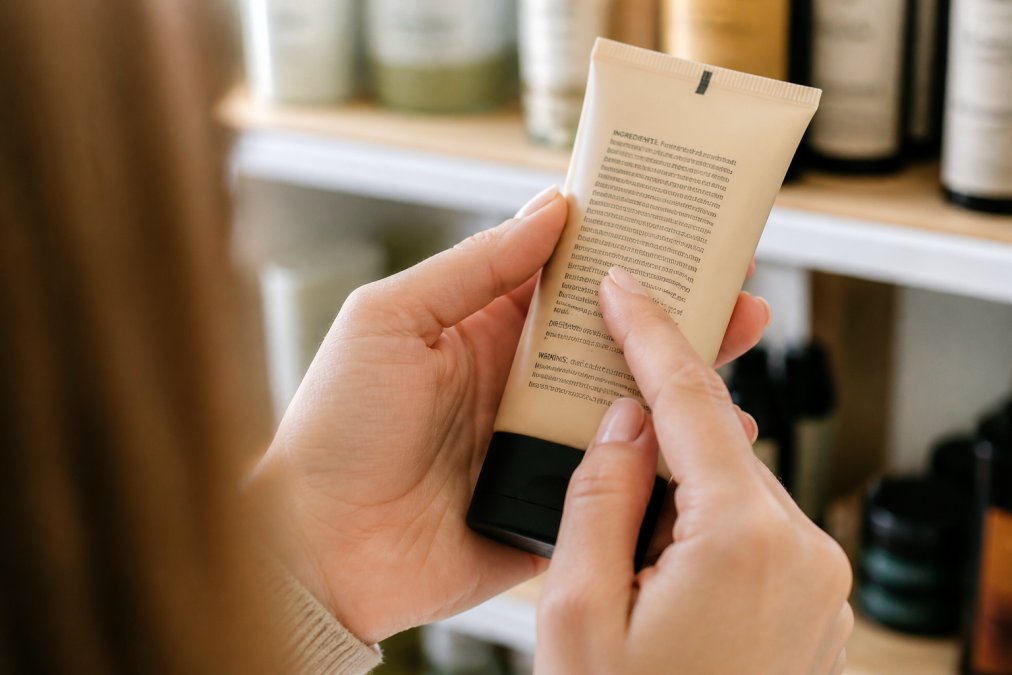
Cosmetic ingredients are listed in descending order by weight; the first five make up the bulk. But ingredient order alone doesn't tell the full story, you also need to understand concentration thresholds, the point at which a chemical becomes biologically significant.
Your skin is a barrier, not a sponge. The stratum corneum blocks most large molecules, but smaller molecules, especially in solvents like propylene glycol or alcohols, penetrate readily. The type of ingredient matters as much as its position on the label.
Hydrophilic (water-loving) ingredients like glycerin sit on the surface with low absorption risk. Lipophilic (fat-loving) ingredients like oils penetrate the lipid layer with moderate risk. Penetration enhancers like alcohol actively push chemicals through the barrier with high absorption risk.
A paraben at position 8 might be 0.5% of the formula, roughly 2.5 milligrams per daily application, or 900 milligrams yearly. That's enough to trigger concern, especially across multiple products. Conversely, a fragrance chemical listed last but in an alcohol-based carrier may absorb at higher rates despite lower concentration.
First 3 ingredients dominate the formula's base. Ingredients 4-8 contain active ingredients and preservatives (where concern chemicals appear). Ingredients 9+ are trace amounts with lower individual risk. Check the carrier: parabens in alcohol-based products absorb higher than in water-based creams. A foundation with "water, talc, mineral oil, parabens" has higher absorption risk than one with "water, glycerin, titanium dioxide, parabens."
Spotting Hidden Toxic Names
Brands sometimes use technical names to hide harmful ingredients. Here's what to watch for:
- Methylparaben, propylparaben, butylparaben: Different paraben names; propyl and butyl penetrate more readily.
- Fragrance, parfum, essential oil blend: Often contain undisclosed phthalates (fragrance industry is exempt from full disclosure).
- Dimethicone, cyclomethicone: Non-biodegradable silicones that trap bacteria and sweat.
- Phenoxyethanol: Preservative linked to reproductive harm; absorption increases in damaged skin.
- Formaldehyde releasers (DMDM hydantoin, imidazolidinyl urea): Release formaldehyde, a known carcinogen.
- Petrolatum, mineral oil, paraffin: Petroleum-derived agents that prevent natural moisture regulation.
The more unfamiliar the chemical name, the more reason to research it. Ingredient databases (covered below) help decode these hidden names instantly.
Using the EWG Skin Deep Database Guide
The EWG Skin Deep database is a free tool that rates ingredients and products on safety. Search your product by name, check the hazard score (0-10, where 0 is safest), and review individual ingredient ratings. Scores of 2-3 are generally safe; above 6 suggest concerning ingredients. The database pulls from peer-reviewed research and is transparent about methodology.
Recognizing Greenwashing and Real Certifications
The Regulatory Gap: Why 'Non-Toxic' Has No Legal Definition
The FDA regulates cosmetics but doesn't legally define "non-toxic," "clean," or "safe." It can only ban ingredients after they're proven harmful, a reactive system. The EU uses a positive list approach, banning over 1,300 chemicals outright and requiring safety proof before use. The U.S. has banned or restricted only about 11 chemicals in cosmetics since 1938.
A lipstick legal in the U.S. may contain ingredients banned in the EU, Canada, or Japan. Examples: Lead acetate (banned in EU, permitted in U.S.), Hydroquinone (banned in EU/Japan, available in U.S.), Formaldehyde (banned in EU, permitted in U.S.), Coal tar dyes (restricted in EU, approved in U.S.).
When a brand claims "non-toxic" or "clean," they're often using their own internal standard, not a regulatory one. This is why third-party certification matters more than marketing language.
Third-Party Certifications That Matter
Look for these trusted third-party certifications:
MADE SAFE: Tests for over 1,000 toxic chemicals; one of the most rigorous certifications, aligning with EU standards.
EWG Verified: Confirms products meet EWG's stricter-than-FDA safety standards.
Leaping Bunny: Certifies cruelty-free status (no animal testing at any stage).
NSF/ANSI 305: Certifies organic cosmetics with 70%+ organic ingredients.
Cruelty-Free Kitty: Vegan and cruelty-free certification.
Cosmos Organic: European certification aligning with stricter EU ingredient standards.
These certifications cost money and require ongoing compliance audits. Brands that hold them are serious about safety and willing to meet external accountability.
Common Greenwashing Claims to Skip
Watch out for these greenwashing claims:
- "Natural": Unregulated; arsenic is natural. Many natural ingredients cause dermatitis or photosensitivity.
- "Clean beauty": No legal definition; brands define it however they want.
- "Hypoallergenic": Not regulated; brands self-declare. Still causes reactions in sensitive individuals.
- "Dermatologist-tested": Just means someone tested it; no regulatory standard.
- "Made with organic ingredients": Could be 1% organic, 99% conventional.
- "Clinically proven safe": Vague without specifying concentration, duration, or population.
- "Free from harmful chemicals": Meaningless without naming which chemicals.
Real non-toxic brands are specific. They name what they exclude, provide testing data, and back claims up with third-party certification. Vague claims are red flags.
Your Step-by-Step Checklist for Identifying Non-Toxic Makeup
Use this checklist every time you evaluate a new product:
- Check the ingredient list for parabens, phthalates, and BPA
- Search the product name in EWG Skin Deep database
- Verify the hazard score is below 4
- Look for third-party certifications (Leaping Bunny, MADE SAFE, EWG Verified)
- Read the first five ingredients, avoid talc, synthetic fragrances, microplastics
- Confirm the brand discloses full fragrance ingredients
- Check for heavy metals testing (especially in lip products)
- Review customer reviews mentioning sensitivity or reactions
- Compare ingredient lists across brands in the same category
This checklist takes 5 minutes per product. It's the fastest way to avoid toxic makeup without memorizing chemistry.
Common Mistakes When Shopping for Non-Toxic Makeup
Mistake 1: Trusting packaging claims over ingredient lists. The ingredient list is the only honest document; always verify claims by checking what's inside.
Mistake 2: Assuming expensive means safer. Price doesn't correlate with safety. Read labels, not price tags.
Mistake 3: Switching everything at once. Replace one product every two weeks to isolate reactions.
Mistake 4: Ignoring trace amounts. Even small amounts accumulate daily. There's no safe level of lead or arsenic exposure.
Mistake 5: Overlooking packaging sustainability. Look for brands using recyclable or refillable packaging alongside clean ingredients.
Identifying non-toxic makeup requires reading labels, checking independent databases, and verifying certifications.
Frequently Asked Questions
How do I check if makeup is non-toxic?
Start by reading the ingredient label and cross-referencing it with the EWG Skin Deep database. Look for third-party certifications like Leaping Bunny or USDA Organic. Avoid common toxic ingredients like parabens, phthalates, and synthetic fragrances. Check if the brand provides transparency about sourcing and manufacturing. If you have sensitive skin, patch test new products on a small area first to ensure they don't cause irritation or allergic reactions.
What are the most common toxic ingredients to avoid in makeup?
Key ingredients to avoid include parabens (hormone disruptors), phthalates (found in fragrances), lead and heavy metals (especially in pigments), formaldehyde releasers (preservatives), and synthetic fragrances. Also watch for microplastics in scrubs and shimmer products, BHA and BHT (preservatives), and coal tar dyes. These chemicals can accumulate in your body over time and may trigger sensitivity or allergic reactions, particularly in people with compromised skin barriers.
Does 'natural' on a label mean the product is non-toxic?
No. 'Natural' is largely unregulated and doesn't guarantee safety or non-toxicity. Many natural ingredients can irritate skin or cause allergic reactions. Greenwashing is common in the beauty industry, where brands use vague terms like 'clean' or 'natural' without third-party verification. Always look for specific certifications and check the actual ingredient list rather than relying on marketing language alone.
How do I use the EWG Skin Deep database to verify products?
Visit the EWG Skin Deep database website and search for your product by name or brand. The database assigns a hazard score from 1 (safest) to 10 (most hazardous) based on ingredient safety data. Review each ingredient's individual rating and read the hazard summary. Cross-reference multiple products to compare safety profiles. This tool helps you understand dermatological safety and identify which ingredients pose the greatest chemical exposure risks.