


Is Clean Beauty Worth the Cost? A Real Analysis
Table of Contents
- What Clean Beauty Actually Means (And What It Doesn't)
- The Price Breakdown: Where Your Money Goes
- How to Identify Greenwashing in Beauty
- Is Clean Beauty Safer for Sensitive Skin?
- Clean Beauty vs Conventional Skincare: Performance and Value
- Cost-Per-Use Analysis: The Real Financial Picture
- Is Clean Beauty Worth It? The Verdict
- Frequently Asked Questions
Last Updated: September 24, 2026
What Clean Beauty Actually Means (And What It Doesn't)
Clean beauty has become a dominant marketing term, but the definition varies wildly depending on who's doing the selling. At its core, clean beauty refers to products formulated without certain synthetic chemicals, heavy metals, or ingredients commonly flagged as potential irritants. However, the term itself has no legal definition in the United States. The FDA doesn't regulate "clean" as a category. There's no government standard that separates clean products from conventional ones.
This ambiguity is central to answering the question: is clean beauty worth the cost? You're paying for a brand's interpretation of "clean," not a regulated standard. Some exclude parabens and phthalates; others eliminate sulfates, synthetic fragrances, talc, or formaldehyde-releasers. Marketing buzzwords often overshadow actual ingredient science.
Everything is made of chemicals, water, turmeric, everything. The distinction that matters is whether an ingredient has been tested for safety and performs without harm, not whether it's synthetic or natural. Clean beauty marketing exploits this confusion, positioning synthetic ingredients as inherently dangerous and natural ones as inherently safe. Neither assumption holds up.
The Price Breakdown: Where Your Money Goes
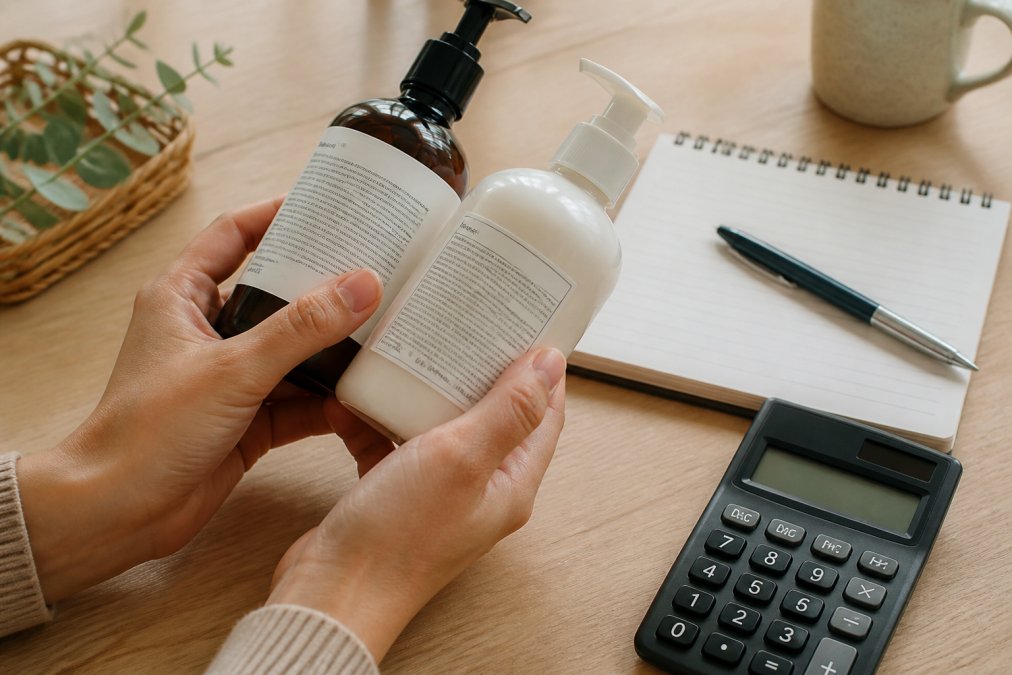
Understanding cost-per-use reveals whether a premium reflects genuine differences or marketing positioning.
Raw Material and Preservation Costs
The largest cost driver is the preservation system. Conventional products use single synthetic preservatives (MIT, parabens) costing $0.15-$0.30 per unit. Clean formulations require multiple natural alternatives, phenoxyethanol, plant extracts, chelating agents, costing $0.40-$0.70 per unit. Clean brands also source organic or non-GMO base ingredients at 20-40% premiums.
Cost-Per-Use Reality Check
A comparable clean moisturizer costs $22-$28 for similar duration: roughly 37-47 cents per day. However, real-world cost-per-use is 15-25% lower because actual consumption patterns are irregular.
For serums, the math shifts. A clean version at $28-$35 lasts similarly. The monthly difference is $3-$5, or $36-$60 yearly, meaningful for budget-conscious consumers but negligible for those spending $150+ monthly on skincare.
Ingredient Sourcing and Supply Chain Transparency
Clean brands invest in supply chain documentation, third-party audits, supplier verification, detailed labeling, adding 10-15% to retail price. Smaller production volumes compound costs: drugstore brands manufacture in batches of 500,000+ units; clean brands produce 50,000. Per-unit overhead is substantially higher despite identical ingredient costs.
Packaging and Regulatory Compliance
Clean brands invest in higher-quality packaging (glass, airless pumps) costing 15-25% more than plastic. They also exceed FDA labeling requirements with sourcing information, concentration percentages, and formulation philosophy, costs conventional brands don't incur.
The Marketing Premium
A $45 clean serum might contain $8-$12 in ingredients and $5-$8 in packaging, with $25-$30 reflecting brand positioning and marketing. This doesn't mean clean products are overpriced, you're paying for transparency, sourcing, and values alongside formulation. Whether that premium aligns with your priorities is an individual calculation.
How to Identify Greenwashing in Beauty
Greenwashing involves marketing products as cleaner, safer, or more natural than they are. Identifying it requires understanding marketing tactics and the regulatory landscape that enables misleading claims.
The Regulatory Gap: FDA vs. EU Standards
The FDA and EU regulate cosmetics very differently. The EU has banned or restricted over 1,300 ingredients; the FDA has banned only 11. The FDA's approach is reactive; the EU's is precautionary. When brands market products as "paraben-free" in the U.S., they're responding to consumer perception shaped by EU regulations, not FDA requirements. A brand claiming "clean" based on excluding ingredients the FDA hasn't banned is making a marketing claim, not a safety claim. Understanding this gap is essential for evaluating greenwashing.
Red Flags in Marketing Language
Radiant Glow Essence with Hyaluronic →
Vague terminology without definition signals greenwashing. Terms like "clean," "natural," "safe," and "non-toxic" have no legal meaning. Legitimate brands provide a "no list" with specific exclusions and reasoning. Greenwashing brands use aspirational language without specificity: "pure," "nature's best," "free from harmful chemicals." Every ingredient is a chemical; the question is whether it's been tested and performs safely at the concentration used.
Certifications: Not All Are Equal
Certification rigor varies dramatically. USDA Organic requires 95% certified organic ingredients and is difficult to obtain. Other "natural" certifications may require only plant-derived ingredients with no restrictions on synthetic preservatives. Research the certifying organization: Does it have published standards? Conduct third-party audits? Maintain a public approved-ingredients list? If a brand claims certification but can't point to the certifier's standards, it's marketing, not substance.
The "Natural Ingredient" Trap
A common tactic: highlighting trendy natural ingredients while burying conventional ones. A "turmeric-infused" product might contain 2% turmeric extract while relying on synthetic emulsifiers and preservatives for 60%. Evaluate the full ingredient list, not the headline. Natural ingredients aren't automatically safer, lavender oil, tea tree oil, and essential oils frequently trigger allergic reactions. "Natural" and "clean" are marketing categories, not safety guarantees.
Price as a Greenwashing Signal
Expensive products can be greenwashed as effectively as budget ones. A $60 serum isn't automatically superior to a $20 alternative. Conversely, budget-friendly products claiming "clean" standards are often greenwashing, the price point doesn't support claimed sourcing or preservation systems. If a clean product costs significantly less than comparable offerings, investigate why.
How to Verify Claims
Request detailed ingredient sourcing documentation. Legitimate brands explain where each ingredient comes from and what testing it carries. Read independent reviews from dermatologists or toxicologists; cross-reference ingredient lists against EWG's database. Test products before committing, a 30-day money-back guarantee reduces risk. If a brand won't stand behind claims with a return policy, that's a warning sign.
Is Clean Beauty Safer for Sensitive Skin?
Clean formulations often exclude common irritants like synthetic fragrances, sulfates, and parabens. For people who react to these, switching to clean products can reduce irritation. However, "clean" doesn't automatically mean hypoallergenic, natural ingredients can cause allergic reactions just as synthetic ones can. The real advantage is ingredient transparency. Clean brands disclose full ingredient lists upfront, allowing people with known sensitivities to avoid specific triggers. Patch testing remains essential regardless of choice. For sensitive skin, clean beauty's advantage is transparency, not inherent safety.
Clean Beauty vs Conventional Skincare: Performance and Value
For moisturizers and serums, clean formulations perform comparably to conventional ones when competently formulated. Hyaluronic acid functions identically regardless of sourcing. Clean beauty sometimes struggles in performance categories relying on synthetic innovation, advanced sunscreens, long-wear makeup, complex actives. However, this gap has narrowed significantly for everyday use. If ingredient sourcing matters to you, clean beauty delivers value beyond performance. If performance is your only concern, conventional drugstore products often deliver similar results at lower cost.

Cost-Per-Use Analysis: The Real Financial Picture
Cost-per-use is where the clean beauty value proposition becomes concrete rather than abstract.
A clean mascara from a quality brand costs around $18 and lasts similar duration, 18 cents per day.
The difference feels significant until you factor in actual usage patterns. Most people don't use the same product every single day. Seasonal variations, travel, and experimentation mean average daily cost is lower than simple division suggests. Additionally, a product that performs better, that doesn't flake, doesn't irritate, doesn't require replacement mid-month, has better actual cost-per-use than the math alone indicates.
For serums and essences, the math shifts further.
Is Clean Beauty Worth It? The Verdict
Whether is clean beauty worth the cost depends entirely on your priorities, budget, and skin type. There's no universal answer.
Frequently Asked Questions
Is clean beauty worth the cost compared to drugstore brands?
Clean beauty products often cost more than conventional drugstore options, but the value depends on your priorities. If you have sensitive skin or prefer transparent ingredient sourcing, the premium may justify itself through fewer irritation issues and longer-term skin health. For performance alone (coverage, staying power), many drugstore products perform equally well. Calculate cost-per-use by dividing the total price by how many applications you get, a $20 clean serum lasting 3 months may cost less per use than a cheaper product that runs out in 6 weeks.
How do I know if a clean beauty product is actually clean or just greenwashing?
Look beyond marketing buzzwords. Check the full ingredient list on the product label or the brand's website, greenwashing relies on vague claims like 'natural' or 'chemical-free' without transparency. Verify third-party certifications (Leaping Bunny for cruelty-free, EWG Verified for safety standards). Avoid brands that hide their full ingredient list or use terms like 'proprietary blend.' Brands like Blush Boutique disclose exactly what's in each product; if a brand won't show you the complete formula, that's a red flag.
Are clean beauty products actually safer for sensitive skin?
Clean beauty can be safer for sensitive skin because it typically avoids common irritants like synthetic fragrances, parabens, sulfates, and phthalates. However, 'clean' doesn't automatically mean hypoallergenic, natural ingredients like essential oils can still trigger reactions. The real advantage is ingredient transparency: you can identify exactly what might irritate you. If you have sensitive skin, patch test any new product first, and look for formulas specifically labeled for sensitive skin or dermatologist-tested, like our Turmeric Radiance Serum, which is designed for all skin types including reactive skin.
What's the difference between clean beauty and conventional skincare in terms of results?
Clinical efficacy depends on the specific formula, not the 'clean' label. A clean vitamin C serum can work as well as a conventional one if the concentration and stabilization are formulated correctly. The main differences are in ingredient sourcing and what's excluded: clean products avoid synthetic chemicals, preservatives like parabens, and synthetic fragrances, while conventional products may include these for shelf-life or cost savings. Both can deliver visible results, the choice comes down to whether you prioritize ingredient transparency, ethical sourcing, and potential skin sensitivity over price.