


Best Cruelty Free Makeup for Sensitive Skin in 2026
Table of Contents
- What Makes Makeup Safe for Sensitive Skin and Cruelty-Free
- How to Check If Makeup Is Cruelty Free
- Hypoallergenic Cruelty Free Makeup: What to Look For
- Top Cruelty Free Makeup Categories for Sensitive Skin
- Gentle Makeup Routine for Reactive Skin
- Budget vs. Luxury Cruelty Free Makeup: Performance Comparison
- Frequently Asked Questions
Last Updated: September 16, 2026
What Makes Makeup Safe for Sensitive Skin and Cruelty-Free
Finding the best cruelty free makeup for sensitive skin starts with understanding two separate questions: what is in the formula, and how was it tested. A product can be gentle on reactive skin and still be tested on animals, or it can be cruelty-free and packed with irritants. You need both.
At Blush Boutique, we hear from shoppers who have been burned by "clean beauty" labels that turned out to mean very little. So let's separate the meaningful claims from the marketing noise.
Cruelty-free makeup is cosmetics produced without animal testing at any stage of development, from raw ingredients through the finished product. Sensitive skin, in this context, describes skin that reacts to irritants, allergens, or fragrances with redness, stinging, itching, or breakouts. The overlap matters because reactive skin narrows your ingredient list at the same time you're filtering for ethics.
Understanding Hypoallergenic and Non-Comedogenic Labels
Hypoallergenic means a product is formulated to reduce the likelihood of allergic reaction, though the term is not a regulated guarantee of safety. Non-comedogenic means the formula is designed not to clog pores. Neither label is a promise, and neither is government-certified.
The FDA guidance on cosmetic labeling notes that cosmetic claims like these are not reviewed or approved before products reach shelves. Treat them as signals, not proof. What actually helps is reading the ingredient list and patch testing before you commit.
How to Check If Makeup Is Cruelty Free
The fastest way to check if makeup is cruelty free is to look for third-party certification, not a brand's own claim. Company statements are easy to make and hard to verify. Independent certification requires documentation.
Here's a practical order of checks:
- Look for a certification logo on the packaging or product page
- Confirm the certifier's database lists the brand, not just the parent company
- Check whether the brand sells in markets that require animal testing by law
- Be skeptical of vague phrases like "cruelty-free philosophy" with no certifier named
Certifications That Matter: Leaping Bunny and PETA
Two certifications carry real weight with conscious consumers. Leaping Bunny is administered by the Cruelty Free International network and requires a brand to meet standards across its entire supply chain, with independent audits. PETA's Beauty Without Bunnies program verifies brands that pledge never to test on animals.
Leaping Bunny is the stricter of the two because it audits suppliers, not just the finished-goods brand. If a company only claims PETA certification, that's still meaningful, but ask whether ingredient suppliers are covered.
| Certification | Who Runs It | What It Verifies | Best For |
|---|---|---|---|
| Leaping Bunny | Cruelty Free International | Full supply chain, independent audit | Shoppers wanting the strictest proof |
| PETA Beauty Without Bunnies | PETA | Brand-level no-testing pledge | Quick screening of smaller brands |
| Self-declared "cruelty-free" | The brand itself | Nothing independently verified | Not recommended as sole proof |
Hypoallergenic Cruelty Free Makeup: What to Look For
Hypoallergenic cruelty free makeup should combine certified animal-testing-free status with a short, fragrance-free ingredient list. Those two filters together eliminate most of what triggers reactive skin. But the ingredient list is where most guides stop, and where they get unhelpful. Knowing why an ingredient irritates skin is what lets you predict a reaction before it happens.
Sensitive skin reactions fall into two broad categories, and they behave differently:
- Irritant contact dermatitis is a direct, dose-dependent reaction. The more you apply, the worse it gets, and it can happen to anyone given enough exposure. This is what sulfates and harsh exfoliating acids typically cause.
- Allergic contact dermatitis is an immune response that can appear after years of safe use. Once sensitized, even trace amounts trigger a reaction. Fragrance components and certain preservatives are the classic culprits.
That distinction matters because a product you've used for years without issue can suddenly cause a reaction if it contains a known sensitizer. It also explains why "I've always used this" is not proof a formula is safe for reactive skin.
Ingredients to Avoid If You Have Reactive Skin
Here is what to watch for, and the mechanism behind each:
- Synthetic dyes and coal tar derivatives, used for vivid pigments. These are among the most common causes of allergic contact dermatitis in cosmetics, which is why the FDA requires certain coal tar colors to carry a warning label when used near the eyes.
- Parabens (methyl-, propyl-, butyl-), preservatives that some reactive skin types tolerate poorly. They are not the villain marketing makes them out to be, but if you've reacted to a product and can't find another cause, they're worth ruling out.
- Sulfates (sodium lauryl sulfate, sodium laureth sulfate), surfactants that strip the skin barrier. This is irritant contact dermatitis in action: the more you use, the more your barrier breaks down.
- Phthalates, often hidden inside "fragrance" blends and rarely listed individually. This is why fragrance-free matters more than unscented.
- Formaldehyde-releasing preservatives (DMDM hydantoin, diazolidinyl urea, quaternium-15), these slowly release small amounts of formaldehyde, a well-documented contact allergen (pubmed.ncbi.nlm.nih.gov).
- Fragrance and essential oils, the single most common cause of cosmetic contact dermatitis. "Natural" does not mean safe here. Lavender, citrus, and tea tree oils are frequent offenders.
- Nickel and cobalt, trace metal contaminants that can hide in mineral pigments. If you've had a reaction to cheap jewelry, this is worth investigating.
A note on "clean" labels: many botanical-rich formulas swap synthetic preservatives for essential oils, which raises the allergen load rather than lowering it.
Top Cruelty Free Makeup Categories for Sensitive Skin
Certain product categories are far easier to get right than others. Mineral makeup tends to be the safest starting point because it uses fewer liquid ingredients and less fragrance. Here's how the main categories stack up:
- Foundation: Choose mineral or cream formulas labeled non-comedogenic and fragrance-free
- Primer: Look for silicone-free options that calm redness rather than mattify aggressively
- Concealer: Cream concealers with soothing ingredients beat long-wear liquids for reactive skin
- Blush: Cream and powder blushes with minimal dyes work best
- Mascara: Hypoallergenic, ophthalmologist-tested formulas reduce irritation near the eyes
Gentle Makeup Routine for Reactive Skin
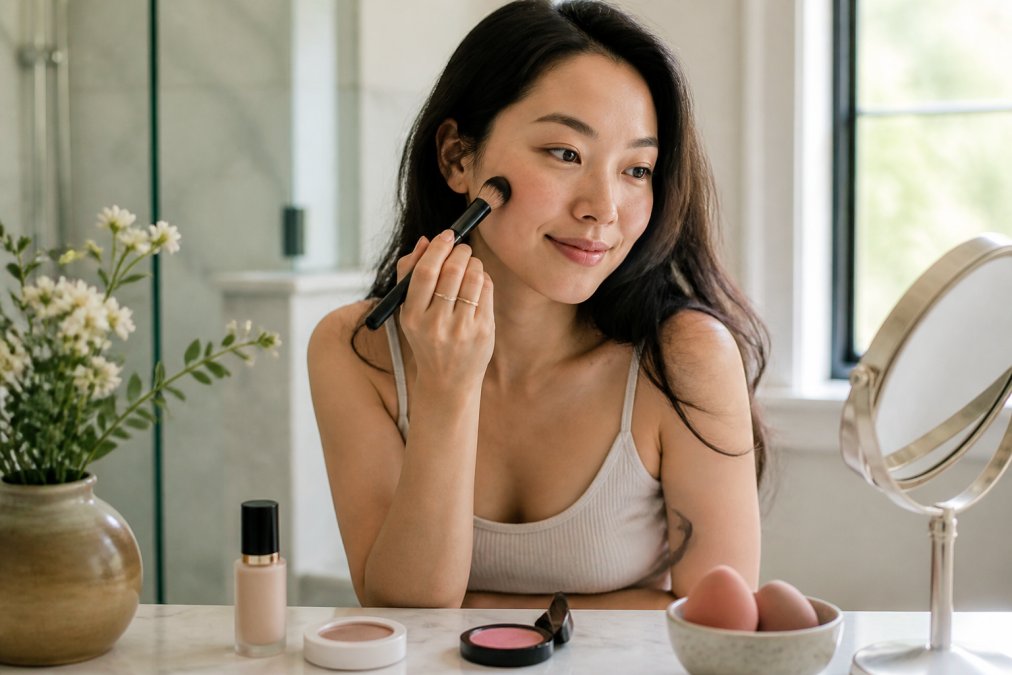
A gentle makeup routine for reactive skin follows three rules: prep with a barrier-supporting moisturizer, apply with clean tools, and remove everything before bed. That's the whole framework.
Patch Testing Protocol for Sensitive Skin
Patch testing is the single most skipped step, and the one that prevents the most reactions. Here is a protocol that works for facial products:
- Clean a small area behind your ear or on your jawline
- Apply a thin layer of the product
- Leave it undisturbed for 24 hours
- Check for redness, itching, or swelling
- If clear, repeat for a second 24-hour period before full use
- Introduce only one new product at a time so you can identify the culprit
Budget vs. Luxury Cruelty Free Makeup: Performance Comparison
The honest answer is that price and performance don't track as tightly as the beauty aisle suggests. Budget cruelty free lines often use the same pigment suppliers as luxury brands. What you pay extra for at the luxury end is usually texture, shade range, and packaging, not safety. But "it depends" is not useful when you're standing in the aisle.
What Actually Differs Between Tiers
Wear time and finish consistency. This is the most reliable difference. A drugstore foundation may separate or oxidize by mid-afternoon where a costlier one holds. For sensitive skin, though, longer wear often means more film-formers and more chances for irritation, so the luxury advantage can work against you.
A Practical Testing Framework
Rather than trusting the price tag, evaluate any formula, budget or luxury, on four questions:
- Is it fragrance-free, not just unscented?
- Does the ingredient list avoid your known sensitizers?
- Does it hold up for the wear time you actually need?
- Does it match your skin tone without mixing?
| Factor | Budget Tier | Luxury Tier |
|---|---|---|
| Pigment quality | Often comparable | Comparable to slightly refined |
| Wear time | Shorter, needs touch-ups | Longer, more crease-proof |
| Shade range | Narrower (10-20) | Broader (30-50) |
| Fragrance risk | Varies widely | Often higher due to botanicals |
| Preservative system | Tried-and-true, well studied | Sometimes weaker in "clean" lines |
| Best for | Everyday wear, testing new shades | Special occasions, extended wear |
Frequently Asked Questions
What is the best makeup brand for very sensitive skin?
The best brand for sensitive skin uses hypoallergenic, fragrance-free formulas and avoids common irritants like synthetic dyes and parabens. Look for cruelty-free certifications such as Leaping Bunny. Mineral-based makeup is often gentler because it sits on the skin's surface. Always patch test new products on your inner arm for 24 hours before applying to your face.
How can I tell if a makeup brand is actually cruelty-free?
Check for third-party certifications like Leaping Bunny or PETA's Beauty Without Bunnies logo. These require brands to prove no animal testing at any stage. You can also look for a clear statement on the brand's website that they do not test on animals or sell in markets that require animal testing. Avoid vague claims like 'cruelty-free' without certification.
Which ingredients should sensitive skin avoid in makeup?
Avoid synthetic dyes (like FD&C colors), parabens, phthalates, sulfates, and formaldehyde-releasing preservatives. Fragrance, even natural, can trigger contact dermatitis. Also steer clear of alcohol denat and essential oils if your skin is reactive. Choose products labeled fragrance-free and non-comedogenic to reduce risk of irritation and breakouts.
Is mineral makeup better for sensitive skin?
Mineral makeup often uses fewer ingredients and lacks common irritants like preservatives and fragrance, making it a good choice for sensitive skin. However, not all mineral makeup is cruelty-free. Check for certifications. Also, some mineral powders can be drying; look for added soothing ingredients like zinc oxide or titanium dioxide, which also provide sun protection.